Research
UX Strategy
A/B Test
UI Design
Prototyping
Company
Rappi
Research
UX Strategy
UI Design
A/B Test
Prototyping
Company
Rappi
Improving the Cash Payment Experience
Improving the Cash Payment Experience
Reducing delivery cancellations caused by missing change.
Reducing delivery cancellations caused by missing change.
Note: UI copy is shown in Spanish, as this product serves Spanish-speaking markets across Latin America.
Note: UI copy is shown in Spanish, as this product
serves Spanish-speaking markets across Latin America.
Context
Cash remains one of the primary payment methods across several Latin American markets. However, many customers completed their orders without indicating how much cash they intended to pay with.
As a result, couriers often arrived without enough change, leading to delivery delays, poor customer experiences, and thousands of preventable cancellations every month.
Cash remains one of the primary payment methods across several Latin American markets. However, many customers completed their orders without indicating how much cash they intended to pay with.
As a result, couriers often arrived without enough change, leading to delivery delays, poor customer experiences, and thousands of preventable cancellations every month.

My role was to redesign the cash payment experience during checkout, increasing the amount of useful information collected before the order was placed while preserving a smooth checkout experience.
My role was to redesign the cash payment experience during checkout, increasing the amount of useful information collected before the order was placed while preserving a smooth checkout experience.
Challenge
The checkout already included a modal for customers to specify how much cash they would use, but it was hidden behind a manual flow. After selecting cash as the payment method, users had to re-enter the payment section and manually access the modal to fill in the amount. Since this step wasn't automatic or easily discoverable, many orders were placed without this critical information.
Without knowing the payment amount in advance, couriers couldn't prepare the correct change before leaving for the delivery.
This created a chain of operational issues:
Delivery delays > Order cancellations due to insufficient change > Additional customer support contacts > Frustration for both customers and couriers
Initial Metrics
Only 10% of customers provided their cash amount.
Approximately 6,500 orders were cancelled every month due to change-related issues.
The checkout already included a modal for customers to specify how much cash they would use, but it was hidden behind a manual flow. After selecting cash as the payment method, users had to re-enter the payment section and manually access the modal to fill in the amount. Since this step wasn't automatic or easily discoverable, many orders were placed without this critical information.
Without knowing the payment amount in advance, couriers couldn't prepare the correct change before leaving for the delivery.
This created a chain of operational issues:
Delivery delays > Order cancellations due to insufficient change > Additional customer support contacts > Frustration for both customers and couriers
Initial Metrics
Only 10% of customers provided their cash amount.
Approximately 6,500 orders were cancelled every month due to change-related issues.
The checkout already included a modal for customers to specify how much cash they would use, but it was hidden behind a manual flow.
After selecting cash as the payment method, users had to re-enter the payment section and manually access the modal to fill in the amount. Since this step wasn't automatic or easily discoverable, many orders were placed without this critical information.
Without knowing the payment amount in advance, couriers couldn't prepare the correct change before leaving for the delivery.
This created a chain of operational issues:
Delivery delays > Order cancellations due to insufficient change > Additional customer support contacts > Frustration for both customers and couriers
Initial Metrics
Only 10% of customers provided their cash amount.
Approximately 6,500 orders were cancelled every month due to change-related issues.
Goals
Business Goals
Reduce cash-related order cancellations. Decrease courier waiting time. Improve delivery operational efficiency.
User Goals
Make paying with cash effortless. Help customers communicate the payment amount more naturally. Prevent issues during delivery.
My Role
As the Product Designer, I was responsible for:
Understanding the operational problem alongside Product and Operations.
Identifying friction points in the existing checkout flow.
Designing and validating new interaction patterns.
Collaborating with Product Managers and Engineers to define experiments.
Measuring success through A/B testing and operational metrics.
As the Product Designer, I was responsible for:
Understanding the operational problem alongside Product and Operations.
Identifying friction points in the existing checkout flow.
Designing and validating new interaction patterns.
Collaborating with Product Managers and Engineers to define experiments.
Measuring success through A/B testing and operational metrics.
Design Hypothesis
We believed that increasing the number of customers who informed their payment amount before placing the order would allow couriers to prepare the correct change in advance, reducing operational friction without significantly impacting checkout conversion.
We believed that increasing the number of customers who informed their payment amount before placing the order would allow couriers to prepare the correct change in advance, reducing operational friction without significantly impacting checkout conversion.
Exploring Different Approaches
Instead of assuming a single solution, we decided to experiment with different levels of user guidance.
Instead of assuming a single solution, we decided to experiment with different levels of user guidance.
Option A — Existing modal
The cash amount modal depended on manual user action instead of appearing at the right moment, making it easy to miss and allowing checkout to continue without this critical information.
Hypothesis: Small UX/UI improvements could increase adoption without introducing additional friction (e.g., Change the chevron to a button to improve clarity).
The cash amount modal depended on manual user action instead of appearing at the right moment, making it easy to miss and allowing checkout to continue without this critical information.
Hypothesis: Small UX/UI improvements could increase adoption without introducing additional friction (e.g., Change the chevron to a button to improve clarity).

Option B — Mandatory Confirmation
Customers were required to select whether they needed change before completing the order.
Hypothesis: Making the interaction mandatory would significantly increase the number of customers providing payment information.
Risk: Additional friction could negatively impact checkout conversion.
Customers were required to select whether they needed change before completing the order.
Hypothesis: Making the interaction mandatory would significantly increase the number of customers providing payment information.
Risk: Additional friction could negatively impact checkout conversion.
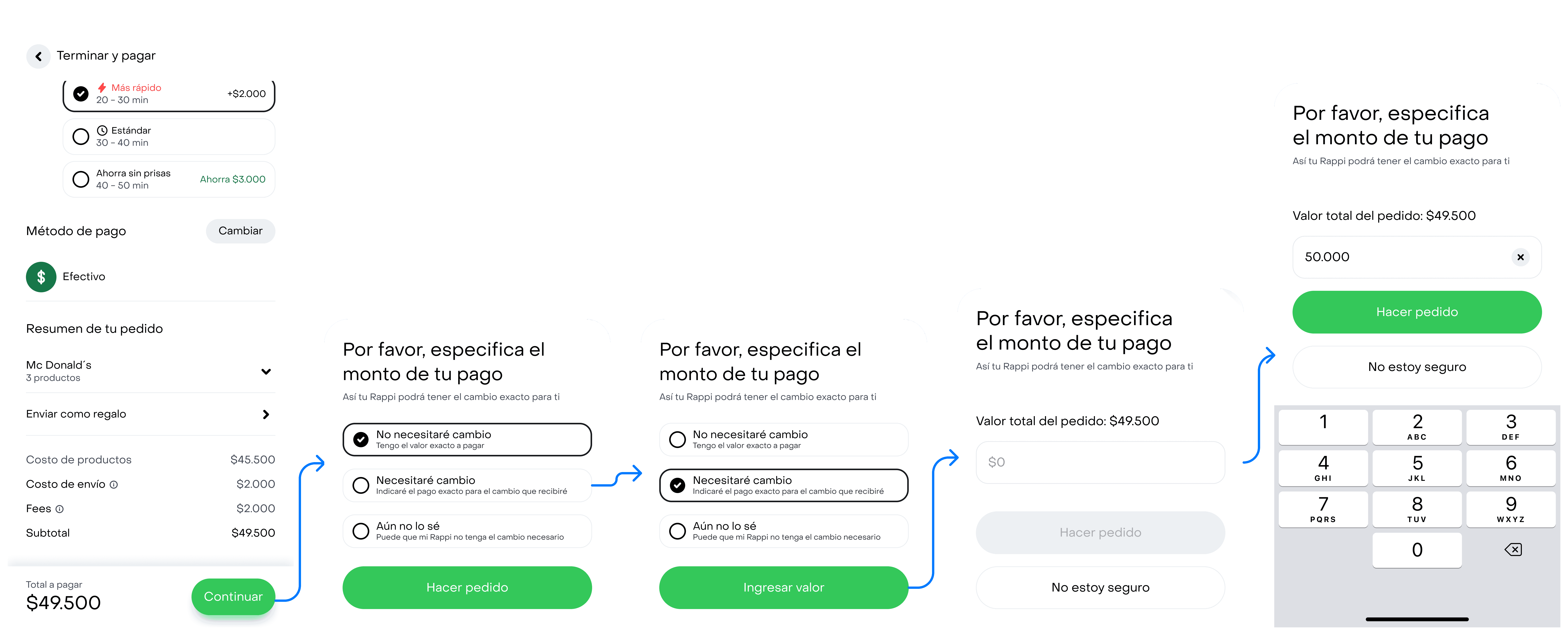
Option C — Dedicated Cash Flow
Instead of showing a modal, customers were redirected to a dedicated screen where they either entered the cash amount or confirmed they didn't need change.
Hypothesis: A dedicated flow would increase completion quality by making the task more explicit.
Risk: An extra page might increase abandonment during checkout.
Instead of showing a modal, customers were redirected to a dedicated screen where they either entered the cash amount or confirmed they didn't need change.
Hypothesis: A dedicated flow would increase completion quality by making the task more explicit.
Risk: An extra page might increase abandonment during checkout.

Measuring Success
To evaluate each experiment, we defined both business and user metrics.
Primary Metric
Cash amount declaration rate.
Secondary Metrics
Cash-related cancellations.
Courier waiting time.
Successful order completion.
Guardrail Metrics
Checkout conversion.
Order creation rate.
This ensured that improvements in operational efficiency wouldn't come at the expense of the purchasing experience.
To evaluate each experiment, we defined both business and user metrics.
Primary Metric
Cash amount declaration rate.
Secondary Metrics
Cash-related cancellations.
Courier waiting time.
Successful order completion.
Guardrail Metrics
Checkout conversion.
Order creation rate.
This ensured that improvements in operational efficiency wouldn't come at the expense of the purchasing experience.
Results
Option B was the best-received solution during validation. By requiring customers to indicate whether they needed change before placing the order, it increased clarity while keeping the checkout experience straightforward. This became the final implementation.
Results
Increased the cash amount declaration rate from 10% to 20% (2x adoption).
Validated that improving the checkout experience encouraged more users to provide the information needed for delivery.
Established a foundation for a second round of A/B tests to further optimize the flow.
Impact
Better information for couriers before starting deliveries.
Reduced operational friction caused by missing change.
Contributed to the long-term goal of reducing cash-related cancellations without harming checkout conversion.
Key Learnings
Small UX improvements can drive meaningful changes in user behavior.
Operational problems can often be solved through better product experiences.
Experimentation is essential to balance user experience and business outcomes, rather than relying on assumptions.
Option B was the best-received solution during validation. By requiring customers to indicate whether they needed change before placing the order, it increased clarity while keeping the checkout experience straightforward. This became the final implementation.
Results
Increased the cash amount declaration rate from 10% to 20% (2x adoption).
Validated that improving the checkout experience encouraged more users to provide the information needed for delivery.
Established a foundation for a second round of A/B tests to further optimize the flow.
Impact
Better information for couriers before starting deliveries.
Reduced operational friction caused by missing change.
Contributed to the long-term goal of reducing cash-related cancellations without harming checkout conversion.
Key Learnings
Small UX improvements can drive meaningful changes in user behavior.
Operational problems can often be solved through better product experiences.
Experimentation is essential to balance user experience and business outcomes, rather than relying on assumptions.
Option B was the best-received solution during validation. By requiring customers to indicate whether they needed change before placing the order, it increased clarity while keeping the checkout experience straightforward. This became the final implementation.
Results
Increased the cash amount declaration rate from 10% to 20% (2x adoption).
Validated that improving the checkout experience encouraged more users to provide the information needed for delivery.
Established a foundation for a second round of A/B tests to further optimize the flow.
Impact
Better information for couriers before starting deliveries.
Reduced operational friction caused by missing change.
Contributed to the long-term goal of reducing cash-related cancellations without harming checkout conversion.
Key Learnings
Small UX improvements can drive meaningful changes in user behavior.
Operational problems can often be solved through better product experiences.
Experimentation is essential to balance user experience and business outcomes, rather than relying on assumptions.
